


The 2025 Asia-Pacific Economic Cooperation (APEC) Summit officially opened in Gyeongju, South Korea on October 31, 2025, gathering 21 member-economy leaders under the theme “Building a Sustainable Tomorrow: Connect, Innovate, Prosper.”
The discussions focused on a changing trade order, geopolitical tensions, digital transformation, and demographic shifts—all under the pressure of global supply-chain volatility.
Key Issues
1) Transformation of the Global Trade and Investment Order
South Korean President Lee Jae-Myung opened the summit by warning that “the Asia-Pacific region stands at a historic crossroads,” emphasizing that the era of unlimited liberalization in trade and investment is giving way to a more fragmented reality.
Canadian Prime Minister Mark Carney declared, “The rules-based free-trade era is over,” highlighting how protectionism and supply-chain nationalism are reshaping global commerce (AP News).
The debate centered on resilience, diversification, and technology-driven services trade as the new pillars of growth.
Consequently, the APEC Leaders’ Declaration reaffirmed that trade and investment remain the backbone of regional prosperity but must be reinforced through “resilient, market-driven, and inclusive cooperation.”
2) U.S.–China Tensions and Supply Chain Stability


U.S.–China relations remained the most delicate geopolitical backdrop (Reuters).
Chinese President Xi Jinping urged collaboration for global supply-chain stability, saying, “The more turbulent the times, the more cooperation we need.”
Meanwhile, Washington hinted at limited tariff relaxation and export-control adjustments, signaling a cautious thaw.
For host Korea, this created an opportunity to act as a bridge nation, balancing between the two powers. The agenda included supply-chain diversification, domestic production resilience, and regional value-chain reconstruction, which dominated the day’s discussions.
3) Digital Transformation and Demographic Change


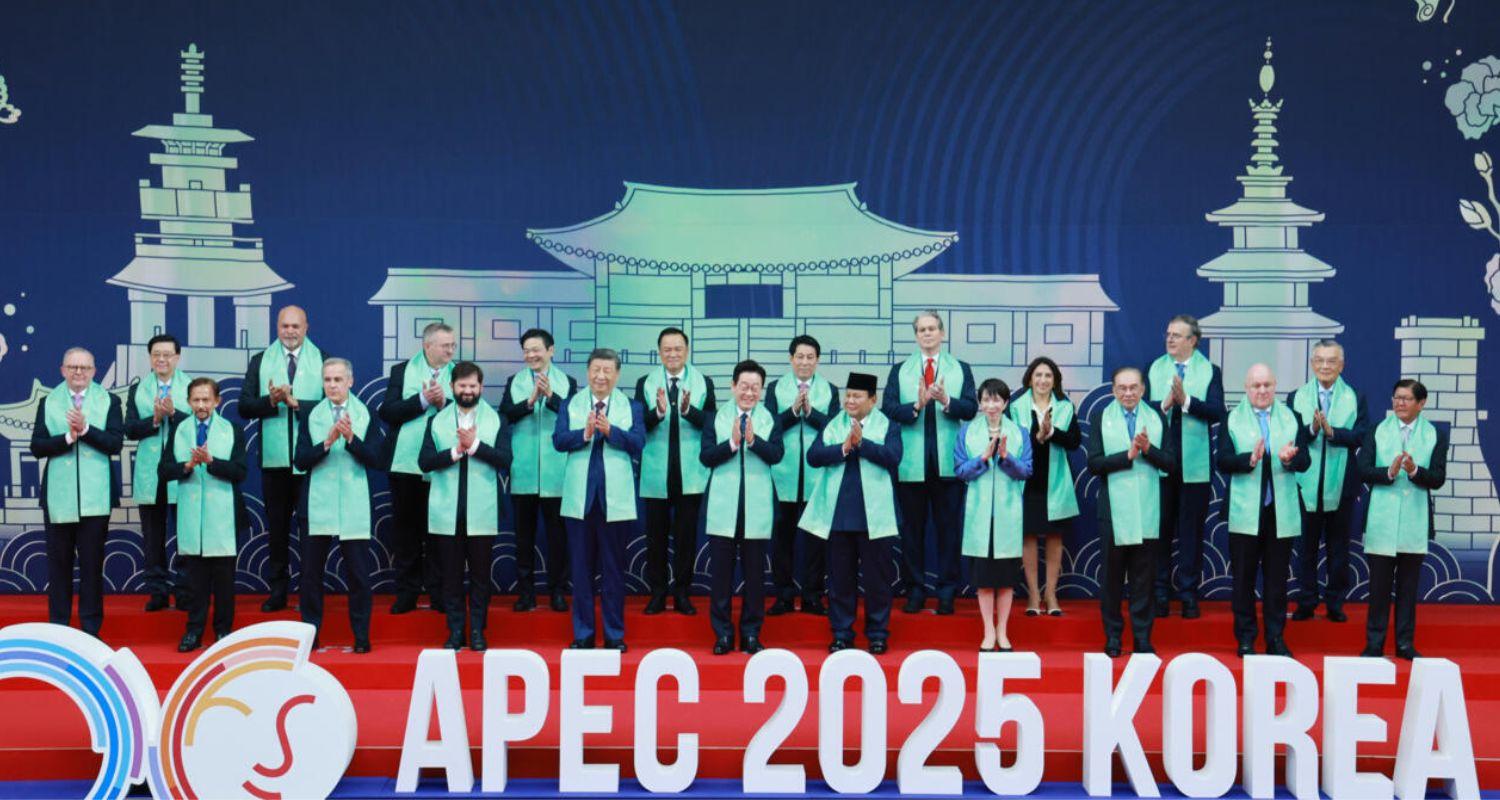

Under the “Innovate & Prosper” pillar, Korea presented proposals on AI cooperation, digital infrastructure investment, and population-aging responses.
APEC members discussed bridging the digital divide, establishing AI regulatory sandboxes, and developing re-skilling initiatives for aging societies (Wikipedia).
The leaders agreed that technology and demographic change are intertwined forces—sources of both opportunity and strain. The summit called for inclusive, sustainable growth, and the declaration explicitly referenced AI collaboration and human-capital mobility.
4) South Korea’s Diplomatic and Economic Strategy
Korea used its host status to showcase itself as the “hub of Asia-Pacific connectivity.” President Lee chaired sessions that explored partnerships with China, the U.S., ASEAN, and Pacific states. (KED Global)
The focus was on merging Korea’s manufacturing base with AI and digital competencies—“Manufacturing + Intelligence.”
By leveraging its strengths in semiconductors, automotive tech, and industrial AI, Korea aims to attract foreign investment and lead a regional supply-chain reconfiguration.
Overall Assessment
The opening day of APEC 2025 in Gyeongju revolved around four themes:
- A new trade and investment order
- U.S.–China tensions and geopolitical balance
- Digital and demographic transformation
- Korea’s strategic middle-power diplomacy
Leaders recognized that the classic free-trade model is no longer sufficient. Resilient, inclusive trade frameworks and tech-enabled integration are now vital.
China’s assertive multilateralism and the U.S.’s lower profile signal a shift in regional dynamics.
Korea framed itself as a balancer that connects growth, innovation, and regional stability through its “Connect-Innovate-Prosper” vision.
Still, analysts note that most agreements remain conceptual; turning them into actionable mechanisms is the next challenge.
NVIDIA’s Strategic Partnership with Korea


One of the most notable corporate announcements during APEC 2025 was NVIDIA’s massive AI chip supply and partnership deal with the South Korean government and major enterprises (Reuters).
- NVIDIA agreed to deliver over 260,000 Blackwell-generation AI GPUs to Korean partners, including Samsung Electronics, SK Hynix, Hyundai Motor, and Naver.
- Roughly 50,000 units will be allocated to the national AI cloud infrastructure, while private firms receive between 40,000–60,000 each.
- These chips will power smart factories, autonomous vehicles, robotics, and next-generation semiconductor manufacturing.
- NVIDIA CEO Jensen Huang stated: “By combining Korea’s AI expertise and manufacturing prowess, we can build a truly intelligent industry.”
The agreement reflects Seoul’s broader plan to transform AI into a core export sector and assert “sovereign AI” capabilities amid global chip export controls.
Beyond hardware, the deal covers joint development of AI ecosystems, digital-twin platforms, robotics applications, and mobility infrastructure—signaling a shift from manufacturing to intelligence-driven industry.
Insights
- The agreement strengthens Korea’s position as a regional semiconductor and AI leader.
- It aligns with the government’s goal to create a comprehensive AI-semiconductor ecosystem spanning research, data centers, and software integration.
- It also highlights how APEC’s economic cooperation is expanding from trade policy to technology sovereignty.
- The deployment of these chips is expected to accelerate Korea’s “Digital Manufacturing 4.0” agenda, boosting innovation in AI, mobility, and industrial automation.
- Nevertheless, the success of this initiative will depend on maintaining a stable chip supply chain and addressing manufacturing capacity constraints.
Conclusion
October 31 marked a pivotal moment for APEC and for Korea as host nation: a day when geopolitics, technology, and trade converged. While leaders debated global rebalancing, Korea’s strategic diplomacy and NVIDIA’s AI partnership underscored that the future of regional growth will be driven by innovation, energy efficiency, and technological sovereignty.
댓글 남기기